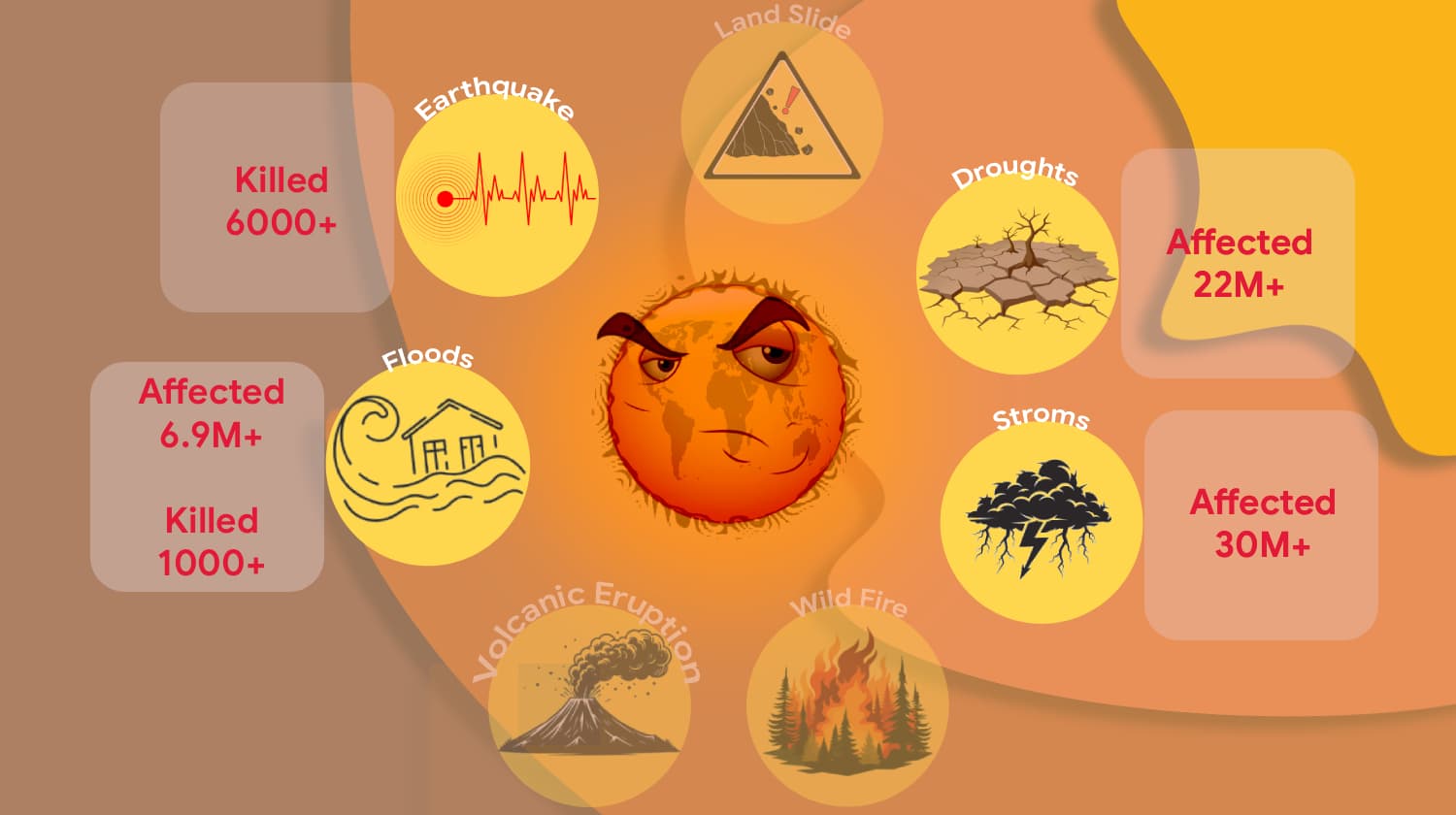
Earth isn't getting angrier. So why does it feel that way?
Scroll through the news on any given day and there is a good chance that somewhere on the planet, something is burning, flooding, shaking or collapsing.
- Analysis
Trending
Analysis -
Illustration: Beyond Headlines
By Beyond Headlines Desk
What if a country could have friends everywhere, and still have no one willing to fight for it?
That question has gained new relevance after this week's Shanghai Cooperation Organisation (SCO) summit in Bishkek, Kyrgyzstan, where member states condemned military strikes on Iran, called them violations of international law, and reaffirmed Tehran's sovereignty.
For Iran, the political backing matters. But there was no NATO-style promise of collective defence.
That distinction captures one of the biggest contradictions of today's emerging multipolar world.
For years, multipolarity has been presented as an alternative to a world dominated by the United States and its alliances. Countries would have more choices: China, Russia, the BRICS grouping, the SCO and a growing network of economic and diplomatic partnerships.
But these relationships are not necessarily alliances in the traditional sense.
The SCO provides a platform for political coordination, security cooperation and economic engagement. BRICS offers another avenue for countries seeking greater economic influence outside Western-led institutions. Neither, however, is a military alliance that obliges members to fight for one another.
That does not make them irrelevant. It simply means their power works differently.
Consider Turkey. A NATO member for more than seven decades, Ankara has simultaneously deepened ties with Russia, China, Iran and other non-Western powers. Turkish President Recep Tayyip Erdogan recently said his country would consider becoming a full SCO member, while stressing that closer ties with the bloc do not mean abandoning its Western alliances.
Brazil follows a similar logic. It has strong economic ties with China, belongs to BRICS and maintains important relationships with the US and Europe. Its objective is not necessarily to choose Beijing over Washington or Washington over Beijing but to preserve room to work with both.
India perhaps provides the clearest example.
New Delhi is part of the US-led Quad, while also belonging to both BRICS and the SCO. At Bishkek, it joined the other SCO members in backing Iran's sovereignty. At the same time, India has a direct interest in keeping the Strait of Hormuz open because of its importance to energy supplies and global trade.
The Gulf states are taking a similar approach. Saudi Arabia, the UAE and Qatar continue to rely heavily on the United States for security, while simultaneously building stronger economic and diplomatic relationships with China, India and other powers.
The message is clear: countries want more options, not necessarily new exclusive alliances. That may be the real promise of multipolarity.
A country can disagree with Washington without becoming an ally of Beijing. It can deepen economic ties with China while maintaining security links with the US. It can cooperate with Russia while remaining part of Western institutions.
This gives greater room to manoeuvre and greater bargaining power.
But there is a catch.
More partnerships do not automatically mean more protection.
Traditional military alliances come with commitments, however complicated or conditional they may be. NATO, for example, is built on a collective-defense promise -- an attack on one is an attack on all. BRICS and SCO are built around cooperation, consultation and shared interests, not a guarantee that members will go to war for one another.
Iran's experience in Bishkek therefore offers a useful lesson about the world that is taking shape.
The old alliance system is not disappearing. Instead, a more flexible system is growing alongside it -- one in which countries accumulate partnerships, diversify their relationships and avoid putting all their strategic eggs in one basket.
That may give them more freedom.
But when a crisis becomes existential, they may still have to stand largely on their own.
In the emerging multipolar world, having more partners may mean having more choices. It does not necessarily mean having more protection.
Scroll through the news on any given day and there is a good chance that somewhere on the planet, something is burning, flooding, shaking or collapsing.
- Analysis