A road safety crisis we refuse to fix
Deaths in road crashes have become so routine that they rarely spark outrage, just a resigned scroll past the headline.
- Opinion
Trending
Opinion - -
Photo: The Economic Times
Our mornings begin with heartbreak.
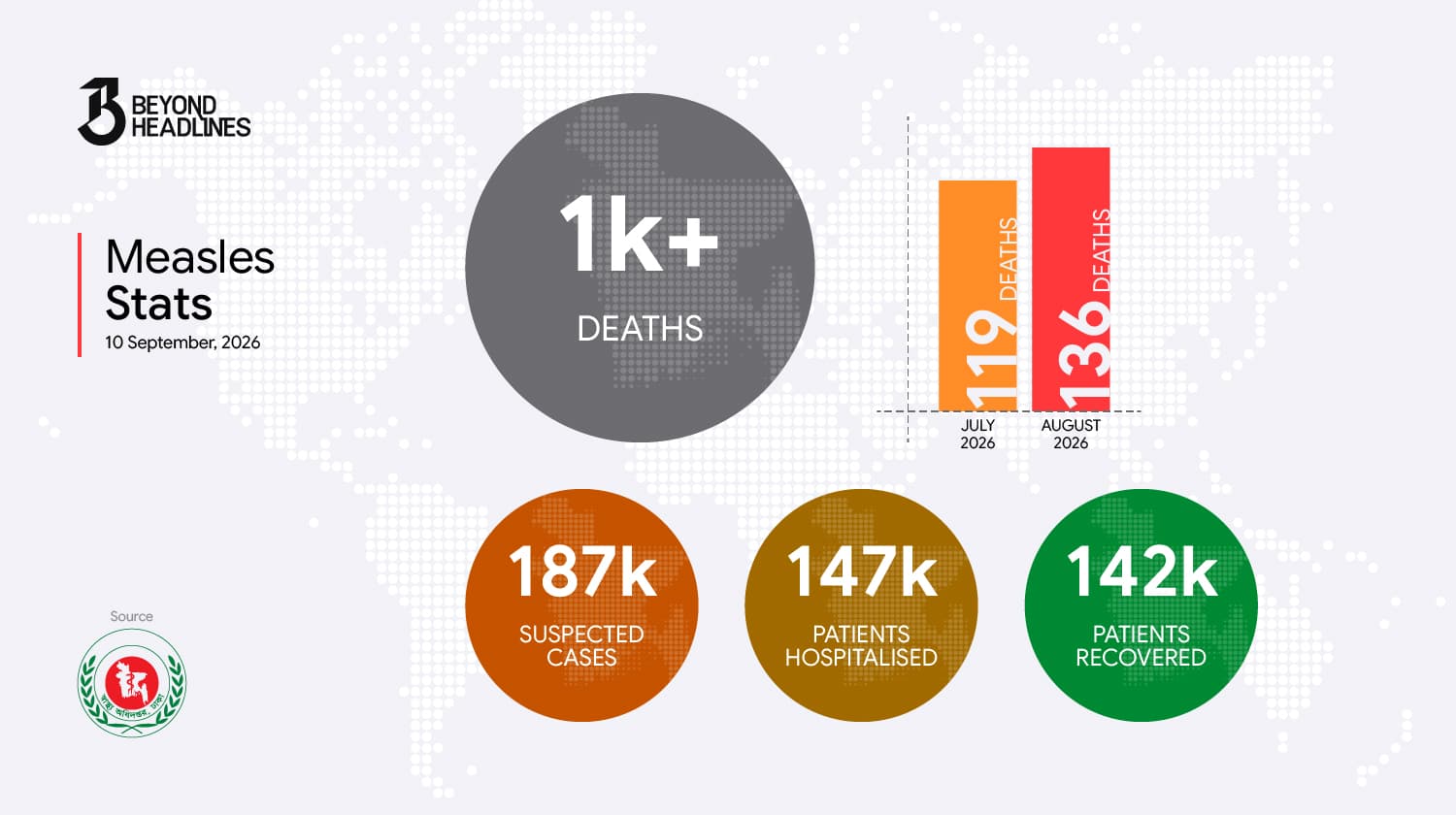
Almost every day, we wake up to the news of another child lost to measles or measles-like symptoms -- another name added to a toll that refuses to fall. As of September 9, the number of children who have died of confirmed or suspected measles crossed a grim milestone of 1,000, according to the Directorate General of Health Services (DGHS). More than 1,87,000 suspected cases have been recorded since the outbreak began on March 15.
The US Centres for Disease Control and Prevention (CDC) describes Bangladesh as currently experiencing the biggest measles outbreak in the world, with hospitals struggling with overcrowding, shortages and a continuing influx of sick children.
What makes the numbers even more disturbing is that the outbreak is showing signs of resurgence. After cases, hospitalisations and deaths declined for two months following the nationwide vaccination campaign, all three indicators rose again in August. There were 136 deaths -- an average of 4.39 a day -- compared with 119 deaths in July.
So far, more than 147,000 patients with suspected measles have been hospitalised across the country, overwhelming local health infrastructure. Nearly 142,000 have recovered.
But this is not merely a statistic.
Behind every number is a child who will not return home. There is a mother whose arms are suddenly empty, a father returning home without the child whose future he had spent years imagining. There are school uniforms that will never be worn again, books that will remain unopened, birthdays that will never be celebrated.
For those families, 1,000 is not any number. It is 1,000 futures lost. And for parents whose children are still fighting the disease in overcrowded wards, every night brings a terrifying question: will my child survive until morning?
The loss of so many young lives should compel us to ask: why are we still failing to protect the most vulnerable among us?
The loss of so many young lives should compel us to ask: why are we still failing to protect the most vulnerable among us?
Bangladesh's current outbreak is the consequence of immunity gaps that accumulated over time. The World Health Organization has pointed to disruptions in routine immunisation from 2020 to 2024, spanning two administrations. A supplementary vaccination campaign scheduled for 2024 was postponed and eventually cancelled, further widening the immunity gap.
The country typically procures around 70 million doses a year, but only 17.8 million doses were secured in 2025, leaving central vaccine stocks severely depleted by the time the outbreak began.
When the outbreak started spreading rapidly in March, the current government responded with an emergency vaccination campaign from April 5, expanding from 30 high-risk regions to a phased national rollout by April 20. By May 20, around 1.84 crore children aged six to 59 months had been vaccinated, exceeding the initial target of 1.8 crore.
But that target had been underestimated.
The nationwide Vitamin A Plus campaign on June 28 exposed the scale of the gap. While 2.23 crore children in the same age group received vitamin A capsules, nearly 39 lakh fewer had received the measles vaccine. The government subsequently acknowledged that its target for the measles campaign had been underestimated and conducted a mop-up drive.
Then there is the harder problem of children who are too young to be vaccinated.
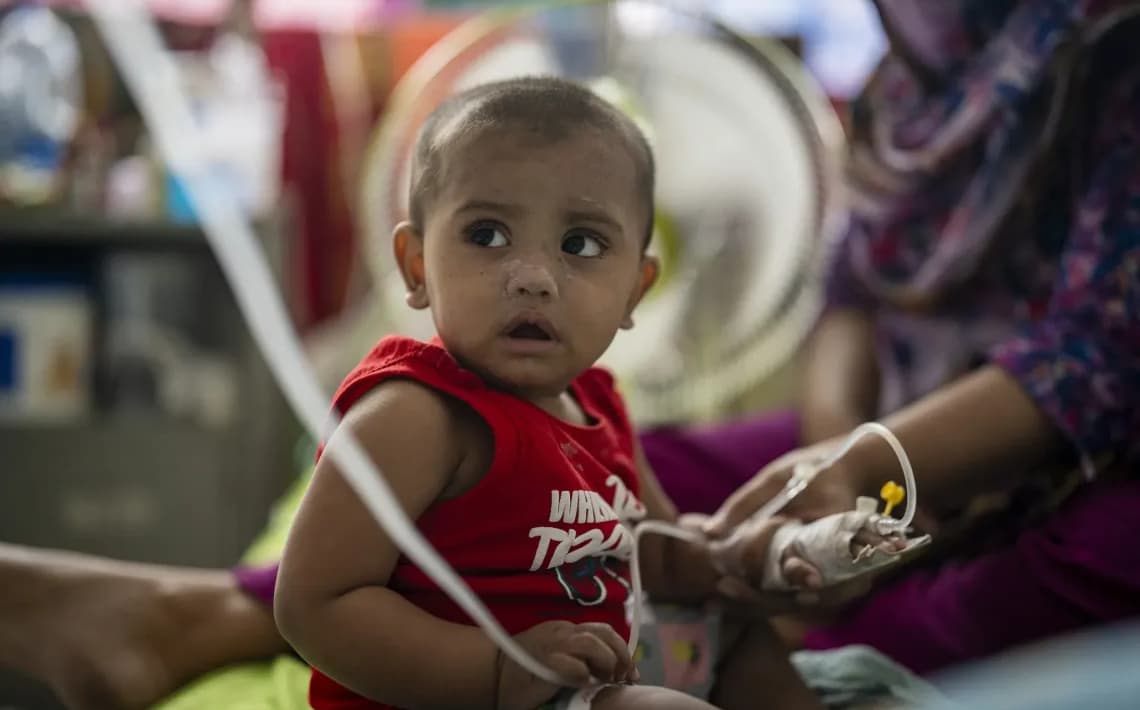
Bangladesh's routine immunisation programme has traditionally administered the first dose of the measles vaccine at nine months of age. But a study by Bangladesh Shishu Hospital and Institute found that 18 percent of children admitted there with measles were under six months of age.
All these failures are now being paid for in lives. A tragedy of this magnitude demands more than a change in the death-toll ticker each morning.
Whatever the precise share of blame -- the previous administration's failure to procure vaccines in time, the current government's miscalculation of how many children needed to be reached, or a health bureaucracy that failed to identify and respond to the growing immunity gap in time -- the nation is paying the cruellest possible price.
But accountability cannot become a political exercise in which one administration blames another and the parents are left with their grief.
A parent whose child lies in a measles ward tonight is not thinking about coverage percentages, procurement decisions or campaign deadlines. They are thinking about whether their child will still be breathing by morning.
Multiply that fear by the tens of thousands of families who have lived through it since March, and by the 1,000 for whom that fear has already become grief.
Accountability must not stop at identifying what went wrong. Those responsible for decisions that contributed to these gaps must answer for them. If vaccines were not procured in time, someone must explain why. If the number of children requiring vaccination was underestimated, someone must explain how. If warning signs were missed, someone must explain why the health system failed to act.
The government now says more vaccines are being procured and a short, intensive programme may be launched to reach children who remain unvaccinated. That is necessary. But the country needs more than another campaign.
It needs a transparent assessment of where the gaps occurred, which children were missed and why, whether vaccine supplies were adequate, whether surveillance worked as it should have, and whether hospitals were sufficiently prepared to prevent avoidable deaths.
Accountability must not stop at identifying what went wrong. Those responsible for decisions that contributed to these gaps must answer for them. If vaccines were not procured in time, someone must explain why. If the number of children requiring vaccination was underestimated, someone must explain how. If warning signs were missed, someone must explain why the health system failed to act.
This is not about punishment for its own sake. It is about ensuring that the same failures do not quietly accumulate again until another preventable disease begins taking children's lives.
Most importantly, families deserve to know when this will end. The goal cannot simply be to bring the daily number of deaths down. The goal must be to bring them to zero.
Bangladesh and the wider WHO South-East Asia Region had set 2026 as the target for measles and rubella elimination. The current outbreak represents a painful reversal of years of progress.
But behind that reversal are children who had names, faces, dreams, and families who loved them.
So, as another day passes and another child fights for life, the question is no longer whether we have done enough. It is whether we are willing to do what is necessary until no parent has to fear that a preventable disease may take their child away.
How many more children must die before this outbreak is truly brought to an end?
How many more families must carry a grief that should never have been theirs to bear?
And, ultimately, how many more mothers' laps must be emptied before we finally decide that enough is enough?