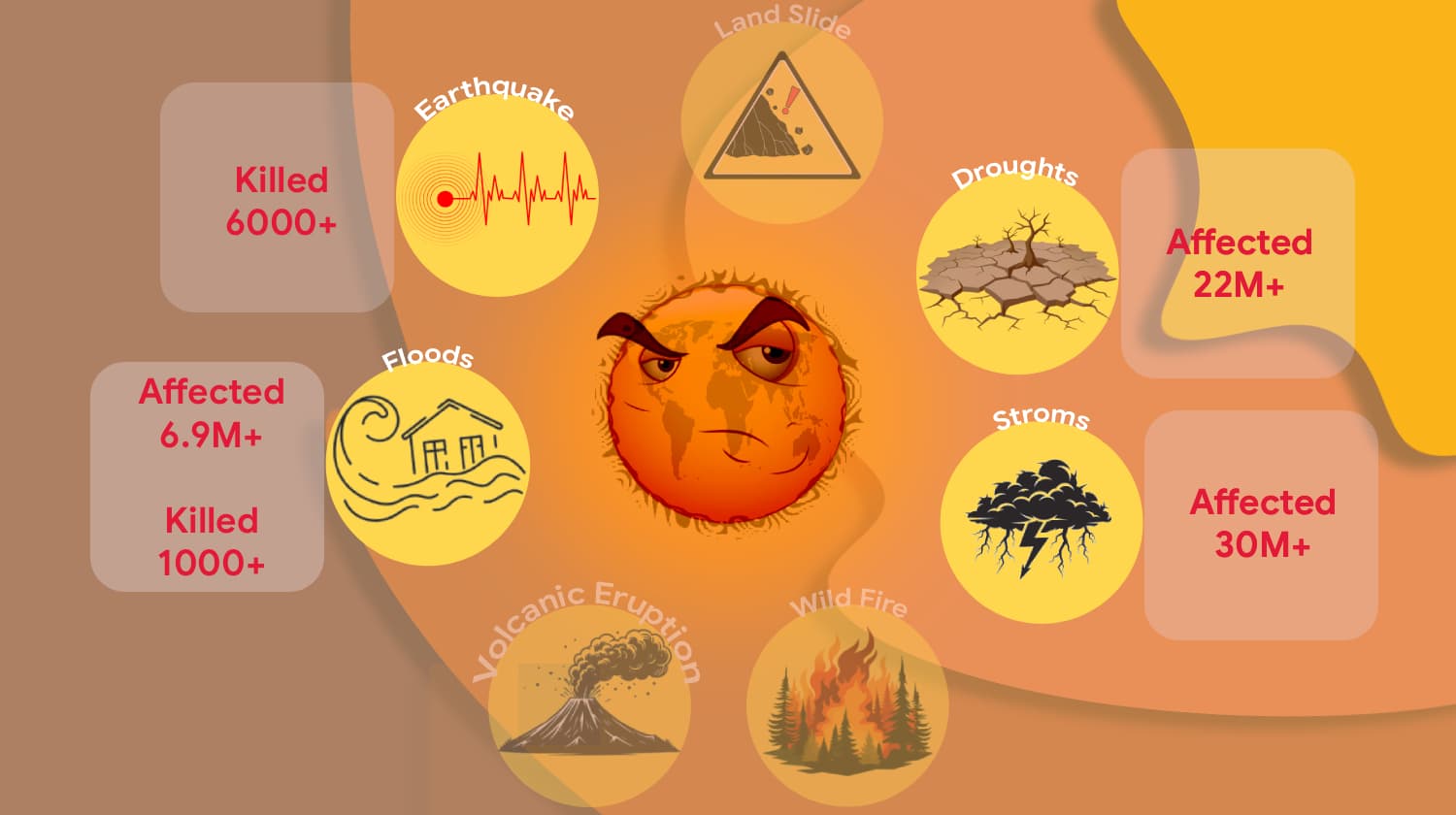
Earth isn't getting angrier. So why does it feel that way?
Scroll through the news on any given day and there is a good chance that somewhere on the planet, something is burning, flooding, shaking or collapsing.
- Analysis
Trending
Food inflation has eased, but rent, utilities, transport and other recurring costs remain high, while wages continue to lag behind the rising cost of living
Analysis - -
Illustration: Beyond Headlines | AI-assisted
When the inflation rate drops, it is supposed to feel like good news.
On paper, the latest figures from the Bangladesh Bureau of Statistics look encouraging. In July, overall inflation fell to 8.32 percent from 9.16 percent in June, its lowest level in eight months. Food inflation fell even more sharply, to 7.16 percent from 8.60 percent.
For a family that has spent two years watching vegetable, rice, and fish prices climb, that fall can mean some relief. Some grocery items may no longer be rising as rapidly as before.
But ask a family dependent on a fixed monthly salary about its finances at the end of the month, and the answer may sound very different.
The rent has not fallen. The electricity and other utility bills have not dropped -- many have risen instead. The cost of commuting to work has not dropped. School fees have not suddenly become cheaper. Nor have most of the other costs that come with simply maintaining a household in urban Bangladesh.
That is the paradox behind the latest numbers: inflation may be easing, but the cost of living still feels painfully high.
The reason lies partly in what is happening beyond the kitchen.
Non-food inflation stood at 9.28 percent in July, more than two percentage points above food inflation. In urban areas, where households are more exposed to rent, transport, education and other services, non-food inflation was 8.90 percent. At the same time, the national Wage Rate Index rose 8.22 percent year-on-year.
Wage growth, in other words, was still trailing both overall inflation and by a wider margin, non-food inflation. For households on fixed or slowly rising incomes, that gap is not a statistical curiosity. It is a continuing squeeze on purchasing power.
Food dominates the inflation conversation because people buy it every day. Its prices are largely hostage to harvests, weather, and seasonal demand. They rise, but they also fall.
When meat gets expensive, a family can buy it less often. When one type of fish becomes unaffordable, it can switch to another. Families can reduce restaurant meals, buy fewer snacks or change the composition of the weekly grocery basket.
But many non-food expenses do not offer the same flexibility.
A family cannot easily tell its landlord that it will pay less rent because inflation eased. A commuter cannot simply stop travelling to work. Parents may postpone buying new clothes or a new appliance, but cutting their children's education is a much more consequential decision.
Healthcare can be delayed for a while, but illness does not always wait for a household budget to recover.
That is what makes non-food inflation especially important for fixed- and limited-income households.
The latest data show that several of these categories eased only slightly in July and remain elevated. Inflation in housing, water, electricity, gas and other fuels was 9.48 percent; transport was 9.34 percent; education was 8.73 percent; and clothing and footwear was 9.75 percent. Health inflation was lower, at 3.90 percent.
Not every non-food item is rising at the same pace. But several of the expenses households have the least ability to avoid are still rising considerably -- and once many of these costs rise, they tend to stay up.
House rent is the clearest example. A household may negotiate a new rate when a lease is renewed, but a reduction rarely follows just because the inflation rate has fallen.
Electricity tells a similar story.
In early June, the Bangladesh Energy Regulatory Commission (BERC) raised retail power tariffs by an average of 16.68 percent from Tk 9.11 per kilowatt-hour (kWh) to Tk 10.63 per kWh, citing the need to reduce the power sector's subsidy burden. The new rates took effect from the June billing cycle.
However, the increase did not apply uniformly. Following concerns over its impact on low-income households, BERC withdrew the hike for residential consumers using up to 75 units, leaving the lifeline rate at Tk 4.63 and the first residential slab at Tk 5.26 per unit.
For ordinary urban households above those consumption levels, the higher tariff added another recurring cost at a time when household budgets were already under pressure.
Fuel prices added to that pressure. In April, the government raised diesel by Tk 15 per litre, octane by Tk 20, petrol by Tk 19 and kerosene by Tk 18. The April increase was followed by another Tk 5 increase in petrol, octane and kerosene in June, while diesel remained at Tk 115 a litre.
Higher fuel costs feed into transport as well as the cost of moving goods around the country.
A low-income household hit by high food inflation may cut consumption quickly because food makes up most of its budget.
But a fixed-income household has a different expenditure structure. A larger share of its income is locked into rent, children's education, commuting, utilities, healthcare, communication and other recurring expenses.
These costs can leave surprisingly little room for adjustment.
When income fails to keep pace, the adjustment happens somewhere less visible than the grocery bill: savings.
None of this would be as damaging if incomes were rising fast enough to absorb the higher costs.
Unfortunately, they have not.
According to BBS data, inflation has outpaced wage growth for 50 consecutive months through March 2026. In March, wage growth stood at 8.09 percent against inflation of 8.71 percent -- a gap of 0.62 percentage points.
The gap narrowed somewhat in the following months, but it did not disappear. In July, wage growth was 8.22 percent, still below both headline inflation of 8.32 percent and non-food inflation of 9.28 percent.
That matters because a salary increase of 8 percent does not necessarily make a household better off if the things it must buy are becoming more expensive by 9 or 10 percent.
The problem is cumulative.
If a household's monthly expenses rose sharply over the past few years, a subsequent fall in inflation does not take those prices back to where they were. It simply means they are rising more slowly.
That distinction is easy to miss in a monthly inflation report but difficult to miss in a household budget.
For Bangladesh's urban fixed-income earners, the current moderation in inflation is welcome but hardly the end of the problem.
Rent contracts are renewed upward. Tariff increases, once introduced, are rarely reversed. Transport costs respond to higher fuel prices. School fees and other service charges can remain elevated. Wage adjustments, where they happen, often lag behind the rise in living costs.
So, the question is not simply whether inflation is falling. It is whether incomes are catching up with the prices households are already paying.
For many families, the answer is still no.
That is why the real cost of inflation may not be visible in the grocery bag anymore. It may be showing up in the savings account.
Scroll through the news on any given day and there is a good chance that somewhere on the planet, something is burning, flooding, shaking or collapsing.
- Analysis