


Economy stabilising - why not businesses?
By Adnan Akib
Long Reads - -
Illustration: Beyond Headlines
Something peculiar is happening in Bangladesh's economy.
The foreign-exchange reserves have recovered, remittances have surged, the taka has become less volatile, and the country’s external position has surely become less precarious than it was before.
Meanwhile, Moody's has moved Bangladesh's sovereign outlook from negative to stable. It said the acute political and external pressures that had driven an earlier assessment have eased.
Yet, one can encounter a different economy while walking into a boardroom, a factory or a bank.
Here, businesses are cautious, investment is weak, credit demand is anaemic, industrial production is contracted, energy costs are rising, and banks – carrying an extraordinary burden of bad loans – are hardly behaving like institutions desperate to lend.
The 4.62 per cent private-sector credit growth in July, reported by the Bangladesh Bank last week, should make the policymakers uncomfortable.
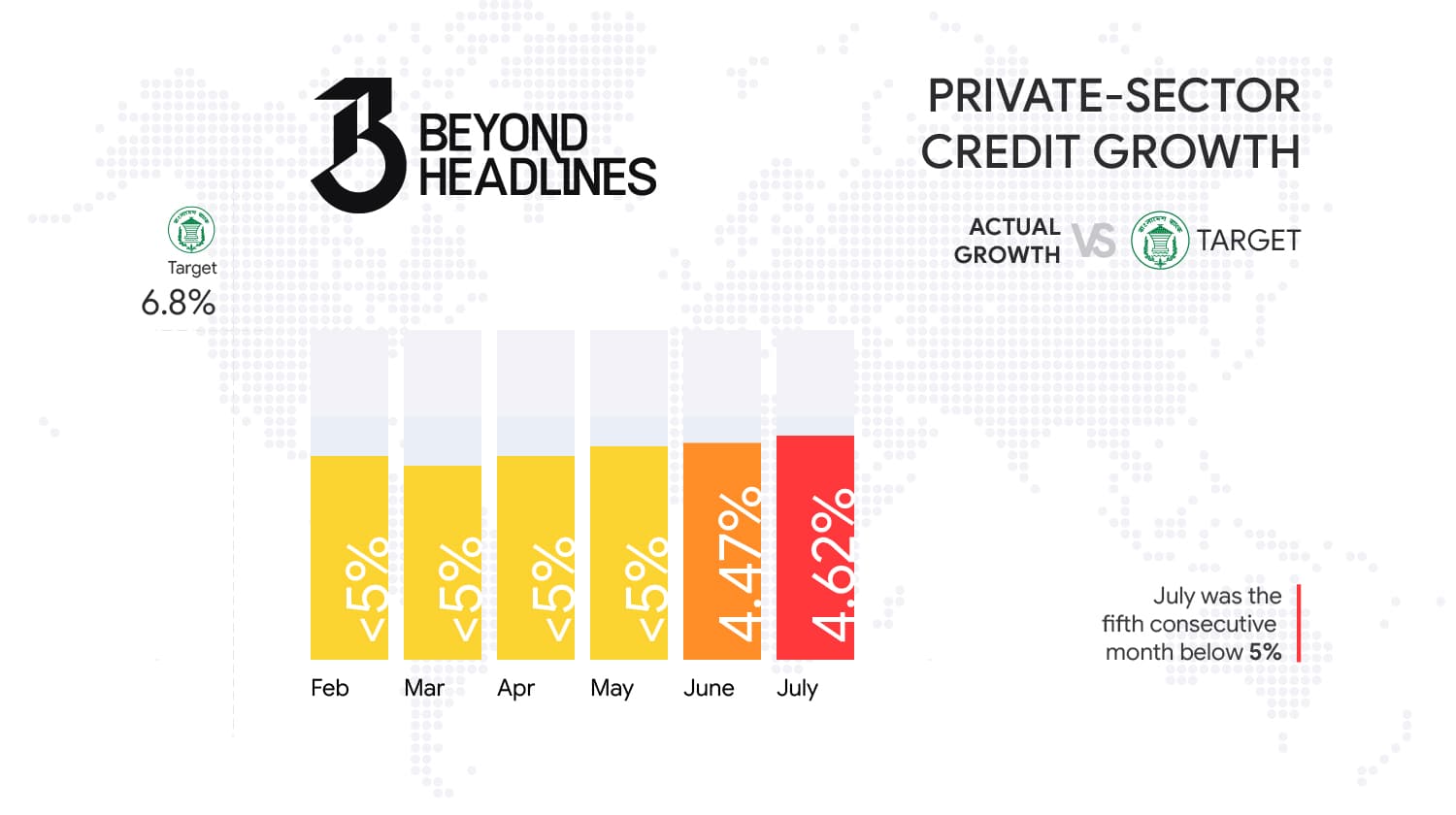
Indeed, this is an improvement on June's record-low 4.47 per cent. However, it is still below 5 per cent for the fifth consecutive month and well below the central bank's 6.8 per cent target.
This is not merely a banking statistic. It also indicates business confidence.
Companies borrow only when they can justify today’s spending for a profitable tomorrow. They then use the borrowed money to build factories, buy machinery, expand warehouses, increase inventories, hire workers, and enter new markets.
If credit demand falls, one must ask why banks are reluctant to lend and why the business community is reluctant to borrow.
Policymakers may also ask whether today’s economy is stabilising at the macro level without yet becoming investable at the micro level.
THE RETURN OF STABILITY IS REAL
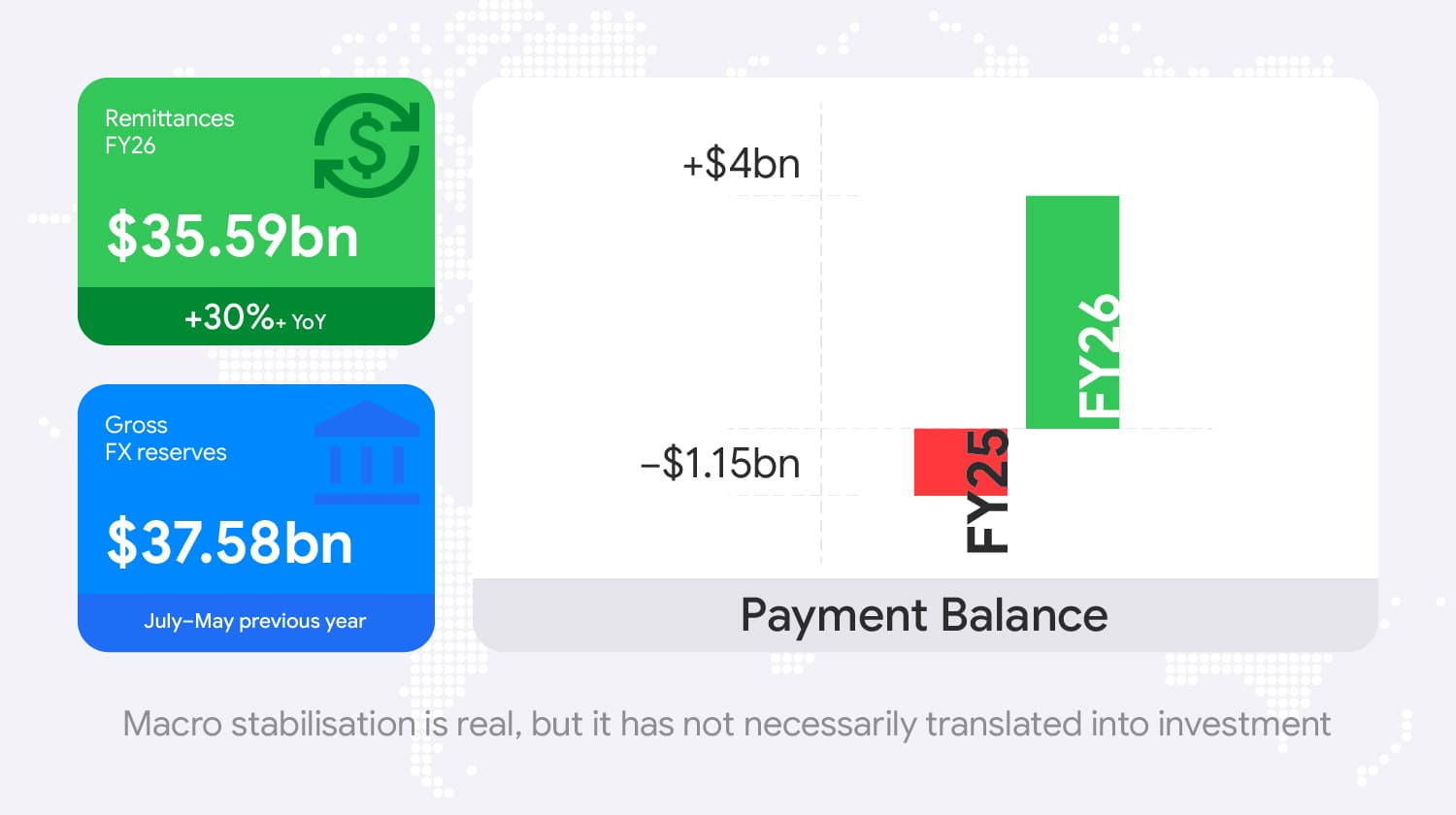
The country’s external position has undergone a significant repair, and it would be wrong to pretend that nothing has improved.
As per the central bank, remittances have gone up by more than 30 per cent from the previous year, reaching $35.59 billion in fiscal year 25-26.
Gross foreign-exchange reserves stood at $37.58 billion at the end of June, while the exchange rate became considerably more stable following the move towards a more flexible regime.
Meanwhile, the overall payment balance swung to a surplus of about $4 billion in July-May from a deficit of $1.15 billion in the corresponding period a year earlier.
They are not merely cosmetic improvements. They definitely reduce the risk of a sudden external financial crisis and give importers more confidence about dollar availability. The central bank also gets more room to manage shocks.
As Moody's revised Bangladesh's outlook to stable in September, the ratings agency acknowledged this. They also pointed to record remittances, stronger reserves, and a more flexible exchange-rate regime as reasons for the improved external position.
Besides, the agency also mentioned that material structural vulnerabilities remained. That caveat is precisely the story.
Businesses do not invest merely because a country has enough dollars in the central bank. They invest when they can reasonably calculate what those dollars, taka, and borrowed funds will earn.
THE INVESTMENT PARADOX
The government repeatedly said that it wanted Bangladesh to be an economy led by the private sector.
In fact, it has launched reform initiatives, activated the Private-Sector Advisory Council, and promised to simplify investment procedures.
BIDA and BanglaBiz are expanding digital services and promoting investment in 19 priority sectors. The government also plans a new Invest Bangladesh Act.
There are even encouraging pockets of investment interest.
BEPZA says it secured investment proposals worth $717.71 million from 36 companies in FY26, with the projects expected to create more than 75,000 jobs.
So, this is not a story of investors abandoning Bangladesh altogether.
It is a story of an economy in which the incentives to invest are colliding with the risks of investing.
The World Bank's diagnosis is instructive. It says private investment remains subdued and that most small and medium-sized businesses face high regulatory costs, unreliable infrastructure, and limited access to finance.
It also identifies electricity reliability, deregulation, competition policy, and streamlined trade policies as critical to private-sector growth.
In other words, the problem is not simply the price of capital. It is the price of uncertainty.
BANKS ARE ONLY THE SYMPTOM
Bangladesh's banking sector is where the country's investment problem becomes painfully visible.
The World Bank reported that the non-performing loan ratio had reached 30.6 per cent in December 2025, while aggregate capital adequacy had fallen below the regulatory minimum.
More recent reporting puts the banking system's default-loan burden above 32 per cent.
Think about what that means from the perspective of a bank manager.
A bank that has spent years accumulating bad loans is not naturally inclined to take large new risks. It needs to preserve capital. It needs to recover existing money. It needs to become more conservative.
However, the economy needs precisely the opposite. It needs banks willing to identify viable businesses and finance them. This is why Bangladesh's credit problem cannot be solved merely by telling banks to lend more.
The banking system needs rehabilitation. It needs capital. It needs governance. It needs credible recovery of bad loans. Above all, it needs to rediscover the distinction between productive risk-taking and reckless lending.
Otherwise, Bangladesh ends up trapped in a particularly nasty feedback loop. Weak banks become cautious. Cautious banks lend less. Businesses invest less. Economic growth slows. Businesses become weaker. And the banks' existing bad loans become harder to recover.
That is not a conventional liquidity problem. It is an institutional problem.
THE COST OF MONEY
Even for companies that can obtain credit, the arithmetic remains difficult.
Bangladesh has spent a considerable period using high interest rates to fight inflation. The policy rate was eventually cut to 9.5 per cent, but market borrowing costs remain much higher for many businesses.
That matters because a businessperson does not care what the policy rate is. He cares about the rate on the loan offered by his bank. And he cares about whether the factory can generate enough additional profit to justify taking that loan.
If financing costs are high, expected returns become uncertain, and demand is weak, the rational decision for many businesses is remarkably simple: Do nothing. Keep cash. Repair existing machinery. Reduce inventories. Delay expansion. Wait.
Waiting may be rational for an individual entrepreneur. Collectively, however, it is devastating for an economy.
INFLATION HASN'T DISAPPEARED
Inflation has moderated, but it remains painfully high.
Bangladesh Bank reported point-to-point inflation at 9.16 per cent in June 2026, while wage growth was 8.18 per cent. That gap matters.
For households, it means purchasing power remains under pressure. For companies, it means customers have less money to spend.
The business community therefore faces two pressures simultaneously. Its costs have risen. Its customers' capacity to absorb higher prices has weakened. That is a recipe for squeezed margins. And squeezed margins are the enemy of investment.
A company does not expand because its turnover is rising. It expands when management believes the additional investment will produce an attractive return after financing costs, taxes, energy costs, wages, and all the other costs of doing business have been paid.
Bangladesh has made that calculation harder.
ENERGY PROBLEM COULD BECOME INVESTMENT PROBLEM
Now comes the issue that could undermine whatever macroeconomic progress has been achieved: energy.
This is not merely about whether factories have electricity. It is about whether an entrepreneur can make a reliable production schedule.
On 14 September, Power, Energy & Mineral Resources Minister Iqbal Hassan Mahmood Tuku said Bangladesh's industrial growth was being significantly hampered by soaring LNG prices and electricity outages.
Bangladesh relies on imported LNG for a large share of its electricity generation, and the disruption to Middle Eastern supplies has forced the country towards more expensive spot-market purchases, he added.
The consequences go well beyond the electricity bill. A factory that cannot predict its power supply cannot optimise production. A manufacturer that cannot predict production cannot reliably promise delivery. An exporter that cannot reliably promise delivery becomes less competitive. And a multinational considering Bangladesh for its next factory notices all of this.
Energy reliability is therefore not an infrastructure issue sitting somewhere in the Ministry of Power. It is an investment-policy issue.
EXPORT NUMBERS WORRYING
Bangladesh's external position looks healthier partly because remittances have been exceptionally strong. However, remittances cannot substitute for export competitiveness.
Bangladesh Bank says merchandise exports grew by only 0.17 per cent in FY26, compared with 8.60 per cent growth the previous year.
That is a striking slowdown.
It also comes at precisely the moment when Bangladesh needs to prepare for a more competitive global trading environment.
The country has been remarkably successful in garments. However, the next phase of economic development cannot depend on garments alone.
Bangladesh needs more pharmaceuticals. More leather and footwear. More engineering products. More electronics. More processed food. More services. More technology. More domestic firms capable of becoming regional companies.
That requires a different kind of business environment – one in which productivity, innovation and capital allocation matter more than access to administrative privilege.
GOVT KNOWS WHAT NEEDS FIXING
The policy response is beginning to recognise the scale of the problem.
The government has announced plans to digitise investment-related services, expand the BIDA One-Stop Service, develop BanglaBiz as a unified platform for business approvals and attract investment into 19 priority sectors. It also proposes measures for renewable energy, export diversification, SMEs and industrial development outside Dhaka and Chattogram.
These are sensible objectives. However, Bangladesh has never suffered from a shortage of policy documents. It has suffered from a shortage of implementation.
For a businessperson, the difference between a regulation being abolished and a regulation being abolished in practice is enormous. The difference between a digital application portal and an approval actually arriving on time is enormous. The difference between an investment incentive appearing in a budget and an investor being able to use it without months of negotiation is enormous.
Businesspeople do not experience economic reform through government announcements. They experience it through the customs officer, the tax office, the bank, the electricity connection, the port, the regulator, and the local administration.
That is where the business climate is actually made.
INCENTIVES NOT COMPETITIVENESS
There is a temptation to answer every investment problem with another incentive.
Give the investor a tax break. Give the industry subsidised credit. Create another economic zone. Offer another exemption. Provide another package.
Some of these measures can be useful. However, incentives cannot compensate indefinitely for an economy in which electricity is unreliable, banks are distressed, regulations are cumbersome, and policy implementation is unpredictable.
A serious investor does not ask only what incentive Bangladesh will give.
The investor asks what happens when the incentive expires. Can s/he repatriate profits? Can s/he get foreign currency when needed? Can s/he obtain land and utilities on schedule? Can s/he resolve a dispute without spending years doing so? Can s/he predict tax liability? Can his/her factory run seven days a week? Can s/he trust the rules to remain broadly stable?
Those questions determine whether an economy is competitive.
SME PROBLEM EVEN BIGGER
The conversation about investment often focuses on large conglomerates and foreign investors. However, Bangladesh's employment engine is much broader.
The World Bank has specifically highlighted the difficulties faced by small and medium-sized enterprises that include regulatory costs, unreliable infrastructure, and limited access to finance.
This matters because small manufacturers do not have the negotiating power of a multinational.
A large company can employ lawyers, maintain government-relations teams, diversify its banking relationships, and build backup power systems. A small business cannot.
If Bangladesh wants broad-based growth, it needs to make the economy easier for the entrepreneur who employs 30 people, not merely the investor who arrives with $300 million. That means simpler taxation, predictable regulation, reliable electricity, accessible finance, faster dispute resolution, and fewer opportunities for arbitrary administrative decisions.
These may sound like boring reforms. In reality, they are growth policy.
COMPLACENCY IS DANGEROUS
The improving macroeconomic indicators create a new danger. They could encourage policymakers to believe that the crisis has passed. It hasn't.
The emergency may be easing. The structural problem remains.
The World Bank has warned that Bangladesh's growth has been constrained by persistent inflation, a stressed banking sector, weak revenue mobilisation and subdued private investment.
In fact, it projected FY26 growth at 3.9 per cent, saying reforms were urgently needed to restore macroeconomic stability, sustain growth and create jobs.
The challenge now is to convert stabilisation into expansion. That is much harder. Stabilisation is about stopping things from getting worse. Investment is about convincing people that things will get better. Those are different political and economic tasks.
A LEGITIMATE INTEREST
The business community has a legitimate interest in lower borrowing costs. But that should not be the whole demand.
If businesses simply ask for cheaper money while the banking system remains damaged, the country risks repeating the very behaviour that created some of its current problems.
The more important demand should be predictability. Predictable taxes, energy, foreign-exchange access, regulation, customs procedures, contract enforcement, and policy.
And a banking system in which credit goes to productive businesses because they are creditworthy – not because they have connections.
That is a much more ambitious agenda than asking for another concession. It is also the agenda Bangladesh needs.
REAL TEST BEGINS NOW
There is an irony in Bangladesh's economic moment.
The country has spent the last few years worrying about whether it could stabilise. Now the question is whether it can turn that stabilisation into confidence.
The reserves can recover. The remittances can rise. The ratings outlook can improve. The policy rate can fall. However, none of those things, by themselves, will build a factory.
A businessperson will build the factory only when the expected return justifies the risk. That is the number policymakers ultimately need to watch. Not just inflation. Not just reserves. Not just GDP.
INVESTMENT
Perhaps the most revealing economic statistic in Bangladesh today is not the one that says the economy is stabilising.
It is the one that says businesses are still borrowing at less than five per cent growth. Because when entrepreneurs are sitting on their hands, the economy does not need another promise. It needs a reason to believe.
Bangladesh now has an opportunity to provide one. However, that reason will not be created in a budget speech or an investment summit. It will be created when a businessperson can walk into a bank, borrow money at a commercially viable rate, connect his factory to reliable power, clear his goods through the port, understand his tax bill, hire workers, export competitively and resolve a dispute without wondering which rule will apply next year.
That is what a genuinely business-friendly Bangladesh looks like. And that is the distance between economic stabilisation and economic recovery.