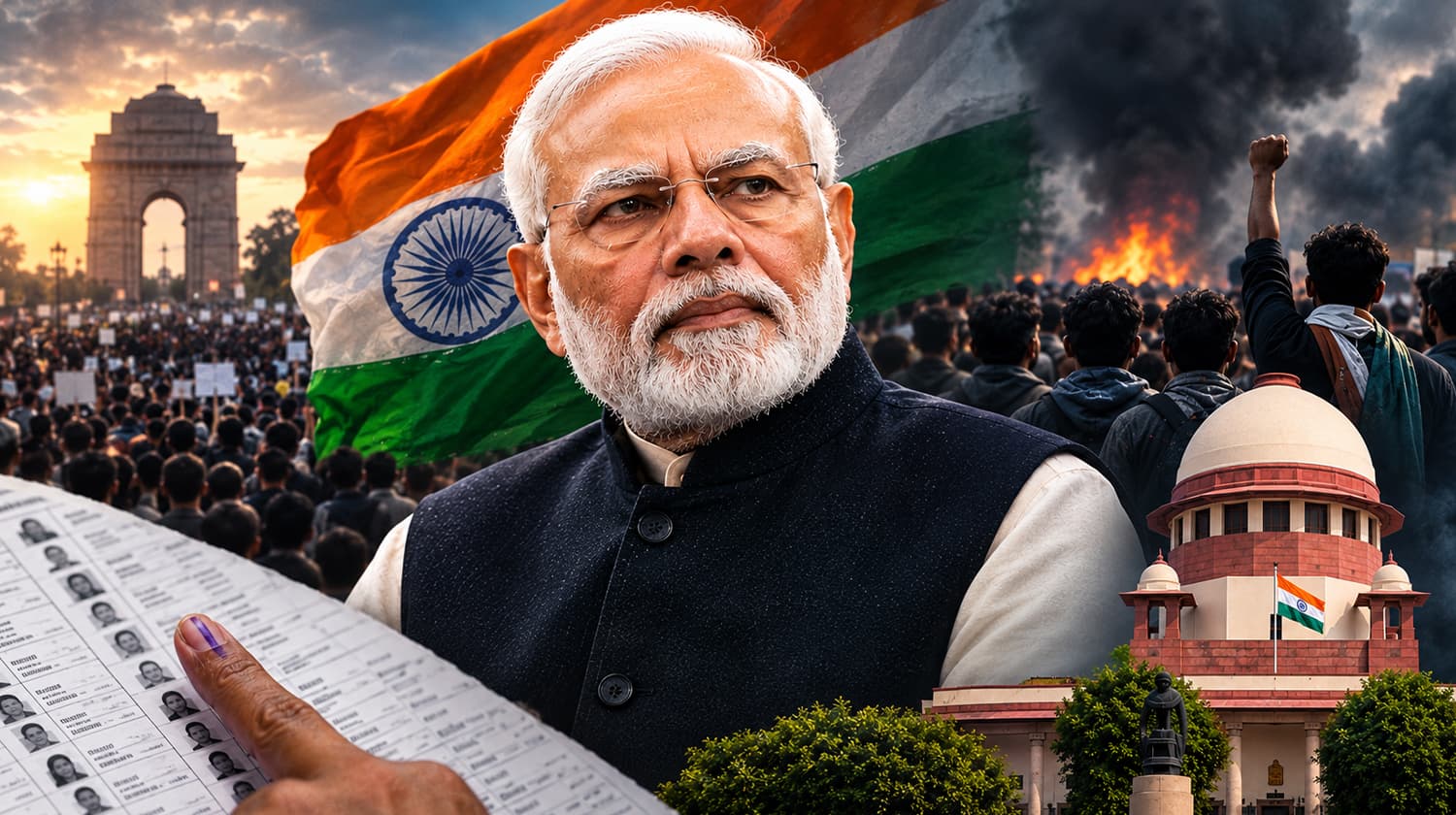
Modi under fire: India’s democratic crisis
India’s political storm is intensifying as voter list irregularities, protests and questions over democratic freedoms put Narendra Modi’s government under pressure.
- Analysis
Trending
By Adnan Akib
Analysis -
Source: Envato Elements
Bangladesh’s ready-made garment (RMG) industry is facing an ‘apparel trilemma’ that threatens its position as a US$40 billion export powerhouse. Labour unrest, the cost of transitioning to greener production, and increasingly stringent international requirements are converging at a time when global buyers remain reluctant to pay higher prices.
The immediate challenge is wage-related unrest. Protests disrupted production across Gazipur, Mymensingh, Savar, Ashulia and Mirpur. By 2 November, industry associations said production had been suspended at around 690 garment factories, affecting more than 17 lakh workers.
In response, the government formed a six-member Minimum Wage Board on 1 November to review RMG workers’ pay. The move did not immediately bring the protests to an end, reflecting the growing tension between workers’ demands for wages that cover basic living costs and manufacturers’ concerns about rising expenses and competitiveness.
The dispute is unfolding alongside another major challenge: financing the industry’s green transition. A joint study by LightCastle Partners and Policy Exchange Bangladesh (PEB) estimates that halving greenhouse gas emissions by 2030 will require US$6.6 billion in investment between 2025 and 2029. Of this, US$1.6 billion has been confirmed and another US$175 million is in the pipeline, leaving a shortfall of US$4.8 billion, or approximately 73 per cent of the required capital.
Together, these pressures form an ‘Apparel Trilemma’: improving workers’ living standards, investing in cleaner production and meeting buyers’ sustainability demands without undermining the industry’s ability to compete.
The living wage gap
The immediate source of labour friction is the widening gap between statutory minimum wages and the cost of meeting basic household needs. Amendments to the Bangladesh Labour Act reduced the interval between minimum-wage revisions from five years to three. With the previous pay scale introduced in December 2023, the current cycle is due to conclude in December 2026.
Persistent inflation has further strained household budgets. Bangladesh Bureau of Statistics data put national point-to-point inflation at 8.34 per cent in September 2026, while urban inflation stood at 8.26 per cent. International Monetary Fund projections indicate average national inflation of 10.9 per cent in FY2026–27.
Research by the Global Living Wage Coalition (GLWC) and the Centre for Policy Dialogue (CPD) provides benchmarks for the cost of decent living. A March 2016 study by Dr ME Khan, Dr Richard Anker, Ms Martha Anker and Dr Sandhya Barge established net living wages of Tk 16,450 for Dhaka city and Tk 13,620 for satellite cities.
GLWC’s November 2025 estimate put the monthly living wage for urban satellite cities surrounding Dhaka at Tk 25,166. The basic cost of decent living for a family of four, with 1.58 workers, was estimated at Tk 39,762.
A separate CPD study by Dr Khondaker Golam Moazzem, Tamim Ahmed and MM Fardeen Kabir analysed 76 RMG enterprises and 228 workers. It found that a Grade 7 garment worker needed Tk 17,568 a month in 2023 to meet basic needs. CPD’s financial modelling indicated that factory owners could absorb this wage without reducing profit margins if global retail brands increased their payments by just US$0.07 per garment.
The finding highlights the potential contribution of even a modest increase in buyer payments to workers’ wages, while raising questions about how factories can meet higher wage expectations with their margins already under pressure.
Financing the green transition
The industry’s capacity to move towards cleaner production is constrained by limited access to affordable finance. Bangladesh Bank introduced its US$200 million Green Transformation Fund in 2016 as a refinancing facility for the textile, leather and jute sectors. It was expanded in June 2019 to cover all export manufacturers. However, tighter financial conditions have restricted credit across the economy.
Private-sector credit growth fell to 4.17 per cent in September 2026, its lowest level since 1993. Meanwhile, non-performing loans at commercial banks reached Tk 6,06,555 crore, or 32.78 per cent of total loans, according to figures highlighted by CPD Distinguished Fellow Dr Fahmida Khatun. The NPL figure relates to June 2026.
The financing constraints are particularly evident in rooftop solar adoption. A CPD study assessed 3,320 RMG factories using satellite-based rooftop mapping and machine-learning electricity-demand models. It identified 1,768 MWp of rooftop solar potential. Such installations could meet a median 39.9 per cent of electricity demand in large factories, 33.1 per cent in medium factories and 38 per cent in small factories.
Of the factories assessed, 2,303 had potential for rooftop solar installations, requiring an estimated investment of US$188.2 million. At a blended financing rate of 9.8 per cent, 509 factories were classified as investment-ready. However, CPD’s analysis found that none remained investment-ready when commercial interest rates reached 10.5 per cent. The findings demonstrate how access to affordable financing can determine whether factories can undertake the transition.
EU regulations and the buyer paradox
The investment challenge is compounded by evolving international sustainability requirements. The Corporate Sustainability Due Diligence Directive (CSDDD) entered into force on July 25, 2024. Its rules were substantially amended in 2026 under the EU’s Omnibus I process. The revised directive entered into force on 18 March 2026. Member states must transpose the amended rules by July 26, 2028, with the provisions applying from 26 July 2029. The revised framework also narrows the scope to very large companies, generally those with more than 5,000 employees and more than €1.5 billion in net worldwide turnover.
The directive establishes corporate due diligence obligations concerning adverse human-rights and environmental impacts across companies’ operations and relevant value chains. It is distinct from the European Sustainability Reporting Standards (ESRS), which relate to sustainability reporting under a separate EU framework.
The EU is a major market for Bangladesh’s garment exports. According to Mahin Afrose, research associate at the Bangladesh Foreign Trade Institute (BFTI), the bloc absorbed US$20 billion, or 45.9 per cent of Bangladesh’s total exports, in FY2022–23. In another study, Dr Mohammad Abdur Razzaque, chairman of Research and Policy Integration for Development (RAPID), puts Bangladesh’s exports to the EU at more than $25 billion in 2023.
RAPID research highlights a mismatch between compliance demands and purchasing practices. Brands are introducing sustainability reporting and audit requirements without necessarily increasing free-on-board (FOB) purchase prices. Citing International Trade Centre data, Dr Razzaque found that Bangladeshi garment producers receive FOB unit prices 32 per cent to 83 per cent lower than the highest prices paid to suppliers in other countries.
Meanwhile, Bangladesh has made substantial progress in green factory infrastructure. According to the Bangladesh Garment Manufacturers and Exporters Association (BGMEA), the country has 291 LEED-certified green garment factories, including 53 of the world’s top 100 green factories.
However, export growth has not translated proportionately into employment. RAPID data show that between 2010 and 2024, RMG exports increased from US$12.5 billion to US$40 billion, while employment remained around four million. Separately, an International Labour Organization (ILO) study found that the sector lost a net 180,000 female jobs between 2017 and 2022, even as overall employment increased by approximately 144,000. Women’s share of the workforce fell to around 39 per cent in 2022.
The price squeeze
The industry’s difficulties ultimately converge on the prices manufacturers receive for their products. Factories of all sizes must compete for orders while absorbing higher costs for wages, energy, financing, compliance and raw materials. Recent developments in the domestic yarn market illustrate the pressure.
On 7 September 2026, the National Board of Revenue (NBR) withdrew bonded-warehouse facilities for imports of 10–30 single-count cotton yarn, requiring eligible exporters to import against bank guarantees. The commerce ministry subsequently sought suspension of the measure on 13 September. On 29 October, however, the High Court suspended the ministry’s letter for three months, while the NBR issued a clarification specifying that the restriction applied to 10–30 single-count cotton yarn. The measure’s implementation has therefore remained contested.
BKMEA Executive President Fazlee Shamim Ehsan alleged that domestic yarn prices had risen by 5 per cent to 6 per cent following the restrictions and that the price gap with Indian yarn had widened. He also mentioned that quoted prices for 30-single combed carded yarn had risen from US$3.65 per kg in August to US$3.80–$3.90. Domestic spinning mill owners, however, have rejected the broader allegations of unjustified price increases.
The dispute illustrates the limited room manufacturers have to absorb higher input costs when buyers resist increases in FOB prices. Rising raw-material prices can further narrow margins, leaving factories with less capacity to accommodate wage adjustments and invest in cleaner production.
Although smaller factories may have fewer financial buffers, the pricing problem extends across the industry. Buyers can demand lower prices alongside higher production and sustainability standards, creating an imbalance between what manufacturers are expected to deliver and what they are paid.
Bangladesh’s RMG competitiveness will therefore depend on a fairer distribution of the costs involved in the industry’s transition. Workers cannot be expected to bear the burden through inadequate wages, while manufacturers cannot indefinitely absorb rising production and compliance expenses without better prices. Unless these competing demands are reconciled, factories, jobs, and export competitiveness will remain at risk.
India’s political storm is intensifying as voter list irregularities, protests and questions over democratic freedoms put Narendra Modi’s government under pressure.
- Analysis

What happens when countries that represent a huge share of the world’s population come together while wars, tariffs and energy crises are shaking the global economy?
- Analysis